
The AI Monoculture: How to Rescue Your Brand's Unique Voice from the Sea of Sameness
Published on December 17, 2025
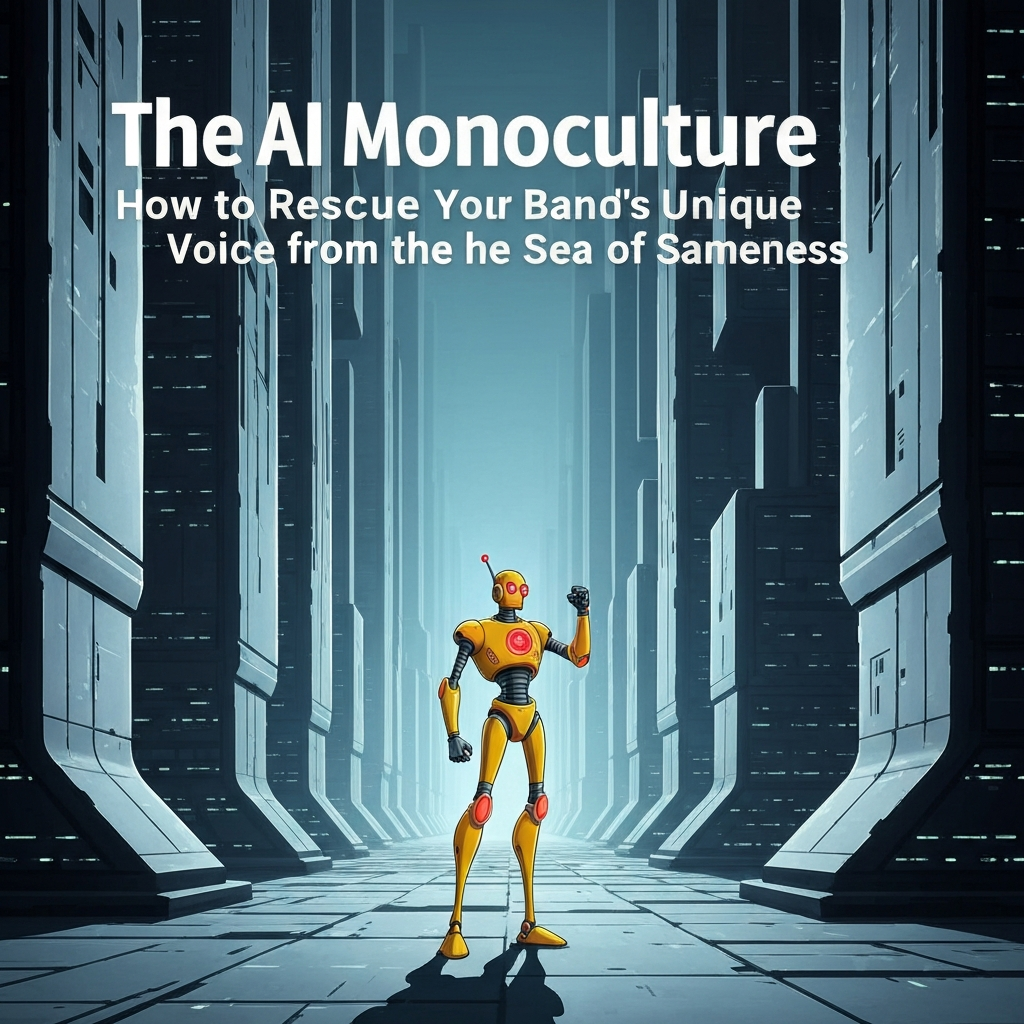
The AI Monoculture: How to Rescue Your Brand's Unique Voice from the Sea of Sameness
There's a quiet hum growing louder in the digital marketing world. It's the sound of servers spinning, algorithms processing, and countless articles, emails, and social media posts being generated at an unprecedented scale. Artificial intelligence has handed us a key to unlock near-infinite content creation. But with this incredible power comes a creeping, insidious risk—a problem we call the AI monoculture. It's the reason your competitor's blog post sounds suspiciously like yours, and why so much of the content flooding the internet feels hollow, repetitive, and devoid of a human soul.
If you're a marketer, brand manager, or business owner, you've likely felt this tension. You embrace AI for its efficiency, but you fear your brand's personality—the very thing that makes you unique—is being diluted in a vast sea of digital sameness. You're not alone. The struggle to maintain a unique brand voice while leveraging AI content creation tools is the defining challenge for modern content strategy. Losing this battle means becoming invisible, forgettable, and ultimately, untrustworthy in the eyes of your audience.
This is not a doomsday prophecy against AI. It is a call to action. AI is a revolutionary tool, but a tool is only as effective as the artisan who wields it. This comprehensive guide is your rescue plan. We will dissect the AI monoculture, teach you how to spot its warning signs in your own work, and provide five actionable, battle-tested strategies to transform AI from a voice-stealing parrot into a powerful co-pilot that amplifies your brand's unique identity. It's time to stop blending in and start standing out.
What is the 'AI Monoculture' and Why is it a Threat to Your Brand?
The term 'monoculture' comes from agriculture, where it describes the practice of growing a single crop species over a wide area. While this can be efficient, it leads to a lack of diversity, making the entire system vulnerable to disease and pests. The AI monoculture in content is strikingly similar. It's the homogenization of ideas, language, structure, and tone that occurs when thousands of businesses rely on the same few Large Language Models (LLMs) trained on the same massive, yet finite, dataset of the public internet.
Think of it this way: LLMs like GPT-4 are designed to be incredible predictors. When given a prompt, they predict the most statistically probable sequence of words to follow, based on the patterns they learned from analyzing billions of web pages, books, and articles. The result is often competent, grammatically correct, and well-structured content. However, it is, by its very nature, an echo of what already exists. It is the 'average' of the internet. When brands use default settings and simple prompts, they are asking for the most average, most predictable output. When everyone does this, you get a digital landscape filled with content that looks and sounds eerily similar.
This phenomenon poses a direct threat to your brand in several critical ways:
- Erosion of Brand Identity: Your brand voice is more than just a collection of words; it's the personality of your business. It encompasses your values, your perspective, and the unique way you connect with your audience. When your content sounds like everyone else's, that identity dissolves. You cease to be a distinct entity and become just another generic provider in a crowded market.
- Loss of Audience Trust: Today's consumers are savvy. They can sense inauthentic, robotic content from a mile away. Content that lacks genuine emotion, personal stories, and unique insights feels sterile and untrustworthy. Building a relationship requires authenticity, and the AI monoculture is the antithesis of that. As a source, The Marketing AI Institute frequently discusses the importance of balancing AI efficiency with authentic human oversight to maintain trust.
- Diminished SEO Performance: Google's ranking algorithms have evolved far beyond simple keywords. With concepts like E-E-A-T (Experience, Expertise, Authoritativeness, and Trustworthiness), Google is actively looking for content that demonstrates real-world experience and a unique, authoritative perspective. If your article on a topic is a mere rehash of the top 10 existing search results—a common outcome of basic AI generation—why should Google rank it? True SEO success now requires the very originality that the AI monoculture destroys.
- Competitive Disadvantage: In a noisy marketplace, your unique point of view is your most powerful differentiator. It's why customers choose you over a competitor. By surrendering to generic AI content, you are voluntarily giving up your greatest competitive advantage. Your brand's voice is a strategic asset, and allowing it to become generic is a critical business error.
3 Telltale Signs Your Content is Losing its Voice to AI
The drift into the AI monoculture can be subtle. It often starts with a single blog post or a few social media updates, and before you know it, your entire content library feels foreign. Here are three warning signs that your brand's voice is being compromised.
The Sound of Sameness: Repetitive Phrases and Structures
AI models have their favorite crutches—phrases and structures that appear with telltale frequency because they were so common in the training data. If you start seeing these pop up in your content, it's a major red flag.
Look for common 'AI-isms' such as:
- "In today's fast-paced digital world..."
- "It's crucial to remember that..."
- "In the ever-evolving landscape of..."
- "Unlocking the potential of..."
- "Navigating the complex world of..."
- Starting multiple paragraphs with transition words like "Moreover," "Furthermore," or "Additionally."
- Ending with a conclusion section explicitly titled "In Conclusion."
Beyond individual phrases, pay attention to structure. Does every article follow the exact same format: a generic introduction, a numbered list of 3-5 high-level points, and a summary conclusion? This predictable formula screams 'AI-generated'. A strong brand voice has a unique rhythm and flow, breaking from convention to keep the reader engaged. Sameness in structure is just as damaging as sameness in vocabulary.
The Empathy Gap: Lacking Genuine Connection and Stories
This is perhaps the most human element that AI struggles to replicate. AI has never felt the frustration of a failed project, the joy of a customer's success, or the humor in a workplace mishap. Because it lacks lived experience, the content it produces often has an 'empathy gap'. It can state facts and provide instructions, but it can't truly connect with the reader's emotions or context.
Content falling into the empathy gap feels like a textbook. It explains the 'what' and the 'how' but consistently misses the 'why it matters to you, the reader'. It lacks personal anecdotes, real-world case studies with genuine struggles, and the passionate, opinionated voice of someone who truly cares about the topic. If your content is informative but leaves the reader feeling cold and disconnected, you're likely seeing the empathy gap in action.
The Insight Void: Generic Information Without a Unique Angle
AI is a master synthesizer, not a creator of net-new thought. It excels at scraping the internet for existing information on a topic and summarizing it coherently. The problem is that this process results in an 'insight void'. The content is accurate on a surface level but offers no unique perspective, no contrarian viewpoint, and no proprietary data that can't be found elsewhere.
This is the difference between mere *information* and true *wisdom*. Information is a collection of facts; wisdom is the application of those facts through the lens of experience. An AI-generated article about leadership might list five common leadership styles. An article written by an experienced leader, however, will tell a story about how one of those styles failed them spectacularly, providing a lesson that is far more valuable and memorable. If your content presents well-known facts without adding your brand's unique analysis, experience, or data, it's contributing to the insight void and becoming part of the noise.
Your Rescue Plan: 5 Actionable Strategies to Humanize AI Content
Recognizing the problem is the first step. Now, it's time to fight back. Rescuing your brand voice isn't about abandoning AI; it's about mastering it. Here are five powerful strategies to put the human element back at the center of your content creation process.
1. Create an 'AI-Ready' Brand Voice & Style Guide
A standard style guide is no longer enough. You need to create a robust, detailed, and 'AI-Ready' guide that can be fed directly into your prompts to instruct the AI on precisely how to write for your brand. This document is your constitution for content.
An AI-Ready guide must go beyond simple grammar and logo usage. It should include:
- Detailed Voice Attributes: Don't just say "friendly." Define it. Are you "friendly like a helpful librarian" or "friendly like a witty best friend"? Use a spectrum. For example: Witty (7/10), Authoritative (9/10), Formal (3/10).
- A Brand Lexicon: Create two columns. Words We Use (e.g., "collaborator," "journey," "uncover") and Words We Avoid (e.g., "synergy," "leverage," "utilize"). Include brand-specific terminology and product names.
- Rhythm and Cadence Examples: Specify sentence and paragraph length. "We prefer short, punchy sentences, rarely exceeding 20 words. Paragraphs should be no more than 3-4 sentences long to enhance readability." Provide examples.
- Our Unique Perspective (POV): This is crucial. What is your brand's core belief about your industry? What is your contrarian take? For example: "We believe most marketing software is overly complicated. Our POV is that power comes from simplicity and focus."
- An Example Library: This is the most important part for training an AI. Provide at least 5-10 examples of 'before' (generic text) and 'after' (text rewritten in your brand voice), explaining the changes made. This gives the AI concrete patterns to follow.
2. Master Prompt Engineering with Your Brand's DNA
The quality of your AI output is directly proportional to the quality of your input. A generic prompt yields a generic result. A sophisticated, brand-infused prompt is your lever for creating on-brand drafts. Treat prompt writing as a critical skill for your team.
A powerful prompt should include these four elements:
- Role & Persona: Tell the AI who to be. Instead of just writing, ask it to *act*. "Act as 'Brand X's' chief content strategist. You are an expert in B2B marketing, with a witty, insightful, and slightly irreverent tone. You write to educate and empower marketing managers."
- Context & Goal: Explain the background and what you want to achieve. "I am writing a 2000-word blog post for our company blog. The target audience is experienced CMOs who are skeptical of AI. The goal is to show them how AI can be a strategic partner without sacrificing brand integrity."
- Task & Constraints: Be specific about the deliverable. "Generate three potential outlines for this blog post. Each outline should include an H1, at least four H2s, and several H3s. The structure must include a section with a practical case study. Avoid using clichés like 'in the digital age'."
- Injecting the Brand Guide: This is the game-changer. Directly paste key sections of your AI-Ready Brand Voice Guide into the prompt. "Here are our brand voice rules. Adhere to them strictly: [Paste your Voice Attributes, Lexicon, and POV here]. Analyze the provided text examples to perfectly capture our tone."
3. Use AI as an Ideation Engine, Not a Final Author
This is a fundamental mindset shift. Stop thinking of AI as a content writer and start thinking of it as the world's most powerful, infinitely patient creative assistant. The final authorship, the soul of the piece, must remain human.
Integrate AI at the beginning of your workflow, not the end:
- Brainstorming Partner: Stuck for ideas? Ask AI: "Generate 20 blog post ideas for an audience of startup founders struggling with scaling. Focus on topics related to leadership and operational efficiency."
- Research Assistant: Need data? Ask AI: "Find five compelling statistics from reputable sources published in the last 18 months about the growth of remote work. Provide links to the sources." This is a well-established use case, as highlighted by a Stanford study on AI's role in research.
- Outline Generator: Have an idea but not a structure? Ask AI: "Create a detailed outline for an article titled 'The Ultimate Guide to Customer Retention'. Include sections on email marketing, community building, and customer service. Suggest a unique angle for each section."
By using AI for the preparatory legwork, your human writers and strategists can focus their energy on what they do best: weaving narratives, adding unique insights, and infusing the content with genuine personality.
4. Inject Your Unique Data, Stories, and Anecdotes
This is your ultimate defense against the AI monoculture. AI can't access your company's private data, your team's personal experiences, or your customers' unique success stories. This proprietary information is your secret weapon.
Make it a mandatory step in your content process to layer these unique elements onto any AI-generated draft:
- Proprietary Data: Did you run a customer survey? Do you have interesting usage data from your product? Turn it into an insight. "While the industry average is X, our data from 10,000 users shows that Y is actually more effective."
- Personal and Team Stories: Share a lesson from a mistake. Tell the origin story of a feature. Let your team's personalities shine through. "Our lead engineer, Sarah, once spent a week chasing a bug that turned out to be a simple typo. It taught us a valuable lesson about..."
- Customer Voice: Don't just state a benefit; prove it with a customer story. Weave in direct quotes and detailed case studies that bring your product's impact to life.
- Strong, Contrarian Opinions: What does your brand believe that others in your industry don't? State it boldly and defend it. This is how you become a thought leader, not just a content producer. You can even use a prompt like, "Here is a common belief in my industry: [state belief]. Act as an industry critic and generate three strong counterarguments to this belief."
5. Implement a Rigorous Human-Led Editing Process
An AI-generated draft should never be published without a thorough human review and editing phase. This is the final and most critical line of defense. We recommend a structured editing framework to ensure consistency and quality.
Consider the A.V.E. Framework:
- A – Authenticity Check: Read the piece aloud. Does it sound like a human from your company wrote it? Hunt down and eliminate any awkward phrasing or generic 'AI-isms' you identified earlier. Does it align with your brand's core values and POV?
- V – Value-Add Edit: This is where you challenge the content's substance. Ask, "Does this piece offer a unique insight that can't be found in the top five search results for this keyword?" If the answer is no, it's time to inject your unique data, stories, or opinions as discussed in the previous step. Add depth, examples, and experience.
- E – Empathy Edit: Review the content from your customer's perspective. Does it speak directly to their pain points? Does it use 'you' and 'your' to make a direct connection? Is the tone appropriate and empathetic to their situation? This is where you transform dry information into a helpful, resonant conversation. For expert guidance on your overall strategy, consider exploring `[Internal Link to Our Content Strategy Services]`.
Case Study: Before and After Humanizing an AI Draft
Let's make this tangible. Imagine a B2B software company wants a short blog post on 'The Importance of Good Onboarding'.
The 'Before' AI Draft (from a simple prompt):
"In the competitive world of SaaS, customer onboarding is paramount. A good onboarding process ensures that users understand the value of your product, leading to higher retention rates. It is crucial to guide new users from the moment they sign up. Effective onboarding can include tutorials, checklists, and tooltips. By investing in onboarding, businesses can unlock customer success and reduce churn."
This is not wrong, but it's utterly forgettable. It's filled with generic statements and lacks any personality or unique value. Now, let's apply our rescue plan.
The Human-Led Intervention:
- Prompting: The team uses a detailed prompt, asking the AI to act as their quirky but brilliant onboarding specialist, 'Professor Finn'. They inject their brand voice guide, which emphasizes storytelling and metaphors related to exploration.
- Injecting Story: A human editor recalls a story about a specific client, 'Acme Corp', who initially struggled. They add this anecdote.
- Adding Data: The team pulls a proprietary stat: "Clients who complete our 'First Milestone' checklist within 48 hours are 4x more likely to remain customers after one year."
- A.V.E. Editing: The editor applies the framework, removing clichés, adding the company's unique POV (that onboarding is a conversation, not a lecture), and ensuring the tone is helpful and empathetic.
The 'After' Humanized Version:
"We used to think of onboarding as a checklist. A series of hoops for new users to jump through. We were wrong. We learned that lesson the hard way with a client we'll call Acme Corp. They had the perfect user profile but were ghosting us after two weeks. Why? Our 'helpful' tutorials felt like a final exam they hadn't studied for. That's when we realized: onboarding isn't a lecture, it's the start of a conversation. It's less about showing every feature and more about guiding a user to their first 'Aha!' moment. In fact, our own data shows that clients who achieve one specific 'First Milestone' with our tool are four times less likely to churn. For Acme Corp, that milestone was creating their first report. By focusing our entire onboarding flow on that single, valuable outcome, we turned them into one of our biggest advocates. So forget the checklists for a moment. What's the first victory you can give your new customer?" Learn more about our approach in our `[Internal Link to Our Onboarding Philosophy Blog Post]`.
The difference is night and day. The 'after' version has a voice, a story, data, and a memorable point of view. It provides real value and builds a connection, all while being built on an AI-generated foundation.
Conclusion: Embrace AI as a Co-Pilot, Not an Autopilot
The AI monoculture is not an inevitability; it's a choice. It's the default setting for brands that prioritize quantity over quality and efficiency over identity. The temptation to set your content creation to 'autopilot' is strong, but the cost—a diluted brand, broken trust, and competitive invisibility—is far too high.
The future of exceptional content lies in a human-AI partnership. It's about embracing AI as a brilliant co-pilot that can navigate, research, and draft at incredible speed, while you, the human captain, retain firm control of the ship's direction, destination, and soul. By building a robust brand voice guide, mastering the art of the prompt, and implementing a rigorous human-centric editing process, you can leverage the power of AI without ever sacrificing the unique voice that makes your brand matter.
Don't let your brand become another echo in the digital chamber. Take control, infuse your content with human experience, and build a brand that stands apart. If you're ready to define a content strategy that protects and amplifies your unique brand voice in the age of AI, `[Internal Link to Contact Us Page]`.