
The Marketer's Maze: Navigating Creative Paralysis in the Age of Infinite AI-Generated Ideas
Published on December 14, 2025
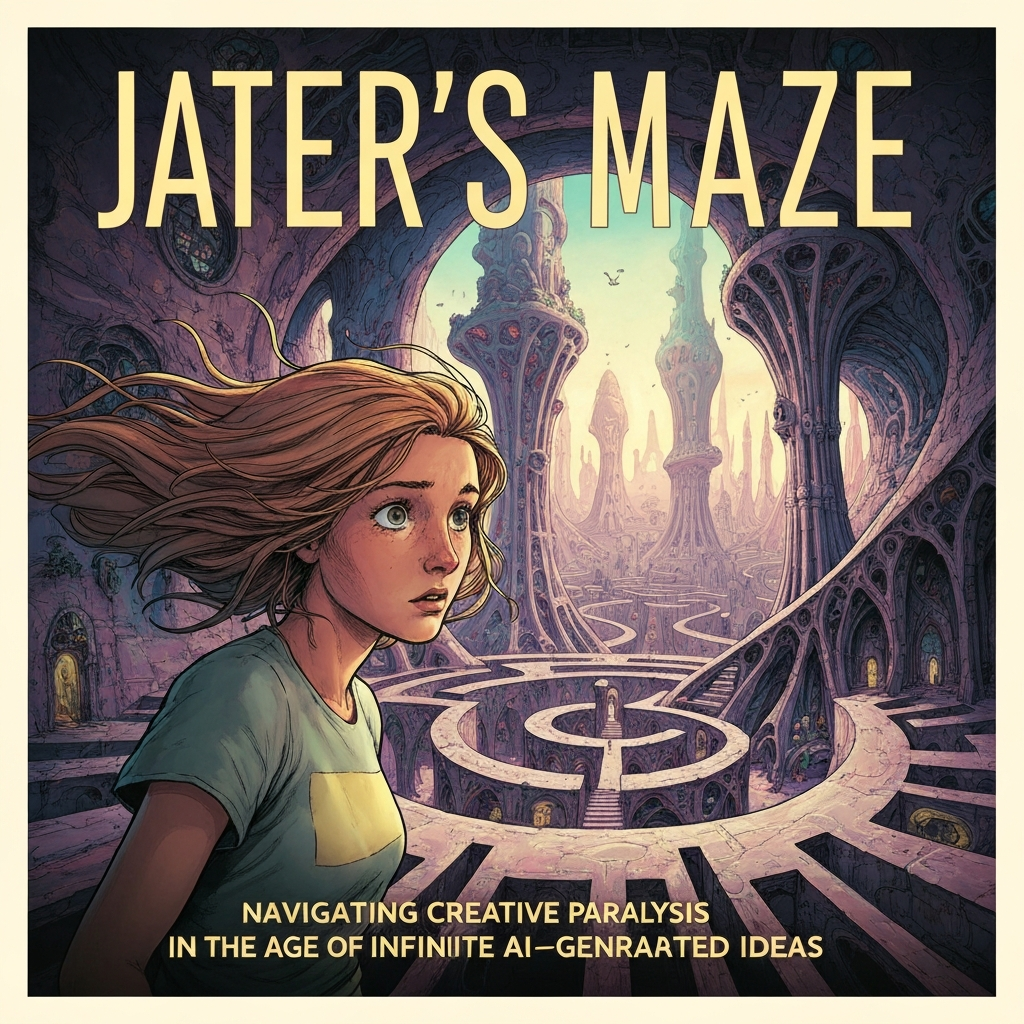
The Marketer's Maze: Navigating Creative Paralysis in the Age of Infinite AI-Generated Ideas
Introduction: The Paradox of Choice in Modern Marketing
In the bustling, ever-accelerating world of digital marketing, we stand at a peculiar crossroads. On one hand, we have access to a technological marvel that promises boundless creativity: Artificial Intelligence. With a few keystrokes, AI tools can generate dozens of blog post outlines, hundreds of social media captions, and a seemingly infinite stream of campaign concepts. On the other hand, many of us are experiencing a phenomenon that feels counterintuitive yet deeply familiar: a profound sense of creative paralysis. This is the marketer's maze—a labyrinth built from the very tools designed to liberate us. We are drowning in a sea of AI-generated ideas, yet find ourselves thirstier than ever for a single drop of genuine, resonant inspiration.
This condition, a modern form of creative paralysis marketing professionals are increasingly facing, is a direct result of the paradox of choice. When presented with too many options, our ability to make a decision plummets. Instead of feeling empowered by the endless possibilities AI presents, we feel overwhelmed. The pressure to sift through a mountain of 'good' ideas to find the 'perfect' one leads to inaction. This AI creative block isn't about a lack of ideas; it's about the overwhelming surplus of them. It’s a state where the sheer volume of content suggestions clouds our strategic judgment, muffles our brand’s unique voice, and leaves us feeling more like content assemblers than creative architects.
This article is your map and compass. We will delve deep into the symptoms of this new-age marketer's creative block, moving beyond the surface-level frustration to understand its root causes. More importantly, we will equip you with five actionable, human-centric strategies to navigate out of the maze. Our goal is not to demonize AI—it is an undeniably powerful ally. Instead, we aim to redefine your relationship with it, transforming it from an overwhelming oracle into a dependable co-pilot. By the end, you'll have a clear framework for leveraging AI's generative power without sacrificing your strategic vision, creative spark, or professional sanity.
Identifying the Symptoms: Are You Trapped in the AI Idea Maze?
Before we can find the exit, we must first recognize that we are lost. The symptoms of AI-induced creative paralysis can be subtle at first, masquerading as diligence or thoroughness. However, they soon coalesce into a significant barrier to productivity and originality. Recognizing these signs in your own workflow is the crucial first step toward reclaiming your creative agency. Do any of the following feel uncomfortably familiar?
The Endless Scroll of 'Good Enough' Concepts
You need a new campaign idea. You turn to your favorite AI tool and prompt it: “Generate 20 innovative marketing campaign ideas for a sustainable coffee brand.” In seconds, it delivers. The ideas are solid: a “bean-to-cup” transparency series, a user-generated content contest, a partnership with local eco-bloggers. They are all technically good. They tick the right boxes. But none of them spark true excitement. So, you click “regenerate.” Another 20 ideas appear, equally competent but equally uninspired. You find yourself in a loop, scrolling through an infinite feed of plausible, 'good enough' concepts. An hour passes, then two. You have hundreds of ideas at your fingertips, but you haven't moved an inch closer to a decision. This is the first major symptom: the paralysis of infinite options. The AI-generated ideas are so plentiful and polished that they create a high floor but a low ceiling for creativity. You become a curator of mediocrity rather than an inventor of excellence, mistaking the activity of generation for the progress of creation.
Losing Your Brand’s Authentic Voice
Another insidious symptom is the slow erosion of your brand's unique voice. AI models are trained on vast datasets from the internet, meaning their output is an amalgamation of what has already been said. It’s the average, the mean, the consensus. When you rely too heavily on AI for content creation with AI, your marketing materials can start to sound generic, stripped of the quirks, opinions, and specific tonality that make your brand unique. You might notice your blog posts sound eerily similar to your competitors'. Your ad copy, while grammatically perfect, lacks the punch and personality that once defined your campaigns. This is the originality in AI content dilemma. Over time, this dependency can cause a marketer's creative block where you forget how to write in your own brand’s voice. You begin to doubt your own turns of phrase, second-guessing your instincts in favor of the 'optimized' but soulless text the AI provides. This homogenization is a silent killer of brand identity, turning a distinctive market player into just another voice in the crowd.
Analysis Paralysis from a Data Tsunami
Modern AI tools don't just generate ideas; they often come armed with a firehose of data—predicted engagement scores, sentiment analysis, SEO keyword density, and more. While intended to help, this data can trigger severe analysis paralysis. You generate five blog titles and the AI tells you Title A has a 78 SEO score, Title B has higher emotional resonance, and Title C is more likely to be clicked on by a specific demographic. Instead of making a confident choice, you're trapped. You spend hours weighing marginal data points, trying to mathematically engineer the 'perfect' piece of content. This obsession with pre-launch optimization, fueled by a tsunami of predictive data, stifles intuitive, gut-driven creativity. The fear of choosing the 'wrong' option, as defined by the AI's metrics, becomes a powerful deterrent to making any choice at all. This marketing content overload isn't just about ideas; it's about the paralyzing weight of data that accompanies them, turning a creative process into a risk-averse analytical exercise.
Your Compass: 5 Actionable Strategies to Escape Creative Paralysis
Recognizing the maze is one thing; navigating your way out is another. The solution isn't to abandon AI but to fundamentally change your approach to it. You must move from a passive recipient of AI-generated ideas to an active director of your creative process. Here are five powerful, human-centric strategies to help you break free from creative paralysis and make AI a true partner in your work.
Strategy 1: Use AI as a Brainstorming Intern, Not the Creative Director
This is the most critical mindset shift you can make. An intern is helpful for research, generating raw material, and handling tedious tasks. A creative director sets the vision, makes the final call, and ensures all work aligns with the core strategy. Your AI is your intern. Treat it as such.
How to implement this:
- Start with a human-first brief: Before you even open an AI tool, develop your core idea, your unique angle, and your strategic goal. What is the one key message you want to convey? What emotion do you want to evoke? Write this down. This is your 'Creative Director's Mandate.'
- Give it specific, menial tasks: Instead of asking, “Give me blog ideas,” give a more specific prompt based on your mandate: “Based on my core idea that 'sustainability is a journey, not a destination,' generate 10 blog titles that use a metaphor of travel or exploration.”
- Use AI for divergence, not convergence: Ask it to explore wild, tangential ideas. Prompts like “What are five completely unexpected ways a coffee brand could talk about recycling?” or “Connect the concept of our software with the philosophy of ancient Stoicism” can break you out of a rut. The goal isn't to find a finished idea, but to find a single, interesting spark that you, the director, can develop.
By framing the relationship this way, you retain full control. The AI provides the clay; you are the sculptor. This simple shift prevents the tool from dictating the direction and ensures the final product is a reflection of your strategy, not the AI's algorithm. It's a key tactic for overcoming creative block in the modern age.
Strategy 2: Implement the 'Human Curation' Framework
This strategy addresses the 'endless scroll' symptom by creating a structured process for handling the flood of AI-generated ideas. Instead of aimlessly sifting, you apply a rigorous, human-centric filter to identify and refine the concepts that truly matter. This turns content overload into a manageable selection process.
The framework consists of three steps:
- Generate Broadly (The 10% Rule): Run your AI prompt, but commit to spending no more than 10% of your total project time on this step. Generate a large volume of ideas (e.g., 50 headlines, 30 campaign angles). Resist the urge to analyze them here. Just generate.
- Filter Strategically (The Brand Alignment Test): Quickly scan the entire list and pull out only the ideas that cause an immediate positive reaction. Don't overthink it. Now, take this shortlist (perhaps 5-10 ideas) and vet each one against three simple questions:
- Does this align with our core brand voice and values?
- Does this genuinely solve a problem or answer a question for our specific audience?
- Does this excite me, the marketer, on a creative level?
- Refine Humanly (The 1+1=3 Method): You should now have 1-3 strong concepts. Now, the real creative work begins. Take a concept and add your unique human element. Combine two different AI ideas into one. Add a personal anecdote. Connect it to a current event. The goal is to elevate the AI's starting point into something that is uniquely yours and strategically sound. This is where your expertise in content strategy truly shines.
This framework re-asserts your role as a strategist. You use the AI for its strength—volume—and then apply your uniquely human strengths—strategic filtering, brand knowledge, and creative synthesis—to produce a superior outcome.
Strategy 3: Set Creative Constraints and Deadlines
The blank page is terrifying, but the infinite page is paralyzing. AI offers an infinite page. The antidote is to introduce deliberate, artificial constraints. Creativity thrives not in absolute freedom, but within a defined playground. Constraints force you to be more inventive and make decisions more quickly.
Examples of effective constraints:
- Time Boxing: Give yourself just 15 minutes to brainstorm with an AI and select a topic. The ticking clock forces you to trust your gut and prevents you from falling into the endless scroll. Parkinson's Law is at play here: work expands to fill the time allotted. Shrink the time.
- Format Constraints: Instead of a generic “blog post,” decide beforehand: “This post must be a step-by-step tutorial with exactly 7 steps,” or “This social campaign must be told entirely through user-submitted photos.” This narrows the AI's input and your focus.
- Word or Character Limits: Challenge yourself to write a concept pitch in under 100 words or a social media caption in under 150 characters. Brevity forces clarity.
- 'Forbidden Word' Constraint: Identify the most common jargon or clichés in your industry (e.g., “synergy,” “game-changer,” “unlock”). Tell yourself—and even instruct the AI—not to use them. This forces you to find more original and compelling language.
By setting these rules before you begin, you build the walls of the maze yourself, but you also design the exit. It transforms an overwhelming ocean of possibility into a focused and manageable creative challenge, which is a powerful tool against marketing burnout.
Strategy 4: Go Analog: Disconnect to Find Real Inspiration
Sometimes, the best way to navigate the digital maze is to leave it entirely. Your best, most original ideas rarely come from staring at a screen. They come from lived experiences, unexpected connections, and moments of quiet contemplation. When you feel the AI creative block setting in, the most productive thing you can do is unplug.
As highlighted in a study from the American Psychological Association, experiences with nature and disconnecting from technology can significantly boost creative problem-solving. This isn't just a nice idea; it's a cognitive necessity.
How to build an analog practice:
- Schedule 'Inspiration Time': Block time in your calendar for non-digital activities. Visit a museum, walk in a park, browse a bookstore, or simply sit in a coffee shop and people-watch. Do not bring your laptop.
- Carry a Notebook: A physical notebook and pen are powerful tools. The act of writing by hand connects to your brain differently than typing. Jot down observations, overheard snippets of conversation, and random thoughts. This becomes your unique, non-algorithmic inspiration feed.
- Read Widely and Weirdly: Read books and articles completely outside of your industry. Read fiction, history, poetry, or science. The cross-pollination of ideas from disparate fields is a wellspring of true originality that no AI can replicate.
When you return to your desk, you bring a fresh perspective that the AI lacks. You can then use the AI to explore the ideas you gathered in the real world, using it as a tool to augment your unique human insights. For idea generation for marketers, nothing beats the raw input of real life.
Strategy 5: Focus on Strategy, Not Just Generation
Finally, a crucial strategy is to elevate your perspective. Creative paralysis often happens when you're stuck in the weeds of content generation without a clear connection to the bigger picture. When you have a rock-solid, well-defined strategy, it becomes the ultimate filter for all creative decisions.
An AI can generate a tactic, but it cannot create a strategy. A strategy answers the fundamental 'why' questions:
- Why are we creating this piece of content?
- Who is it for, and what is their single biggest pain point we are solving?
- What action do we want them to take after consuming it?
- How does this specific piece of content fit into the larger customer journey?
- What is our unique point of view on this topic that no one else has?
Before you generate a single idea with AI, have the answers to these questions written down. Your AI content strategy should guide your prompts. Instead of asking for “social media posts,” you ask, “Generate five witty and empathetic social media hooks for our target audience of burnt-out project managers, addressing their pain point of inefficient meetings, with the goal of driving clicks to our new meeting agenda template.”
This strategic focus makes the AI a far more effective tool and dramatically reduces decision fatigue. You are no longer looking for a 'good' idea; you are looking for the idea that best executes your pre-defined strategy. It's the ultimate compass for navigating the maze.
Putting It Into Practice: A Mini Case Study
Let's see how these strategies work in the real world. Meet Maya, a content manager for a B2B SaaS company that sells project management software. She's been tasked with creating a cornerstone content piece for the company's blog but is suffering from a severe case of marketer's creative block.
The Problem: Maya has spent a week using AI to generate ideas. She has a document with over 200 blog titles like “10 Ways to Improve Productivity” and “The Ultimate Guide to Project Management.” They're all technically sound but feel generic and uninspired. She's stuck in the 'endless scroll' and is feeling immense pressure and marketing burnout.
The Intervention: Applying the 5 Strategies
- Focus on Strategy: Maya steps back from generation. She re-reads her company's core mission and identifies their unique point of view: “We believe project management isn't about rigid rules, but about humane, flexible workflows that prevent burnout.” This becomes her strategic anchor.
- Go Analog: Feeling overwhelmed, Maya takes a long lunch and walks to a local library. She flips through magazines on psychology and leadership. She jots down a phrase that catches her eye: “the art of strategic rest.” This sparks an idea.
- Use AI as an Intern with Constraints: Back at her desk, Maya formulates a specific, constrained prompt based on her new insight: “Using the concept of 'strategic rest' from athletic training, generate 10 blog post angles that apply this idea to project management for preventing team burnout. The tone should be empathetic and authoritative. Avoid using the phrase 'work-life balance'.”
- Implement the Human Curation Framework: The AI returns several interesting ideas. Maya quickly filters them using her strategic questions. She discards generic ones and lands on one that excites her: “The PM's Cooldown: How to Implement 'Strategic Rest' into Your Sprints to Boost Creativity and Prevent Burnout.” It aligns with the brand voice, addresses a key pain point, and feels fresh.
- Refine Humanly: Maya doesn't just use the AI's outline. She interviews two project managers from her own company for personal anecdotes. She weaves in her 'library' insight. She structures the post as a practical playbook, far more valuable than a generic listicle. The final piece is unique, insightful, and deeply aligned with her company's strategy—something the AI alone could never have produced.
By following this process, Maya transformed from a paralyzed curator of generic ideas into a confident creative strategist. She used AI as a powerful tool within a human-led workflow, escaping the maze and creating a piece of content with real value and originality.
Conclusion: Making AI Your Creative Co-Pilot, Not Your Autopilot
The age of AI in marketing is not a dystopian future to be feared, but a new landscape to be navigated with intention and skill. The feeling of creative paralysis marketing professionals are experiencing is not a personal failing; it is a predictable response to a paradigm shift. We have been handed a tool of infinite leverage, and it's only natural to feel overwhelmed by its power. The key is to remember that it is, and always will be, a tool. It is a brilliant accelerator, a tireless researcher, and an endlessly patient brainstorming partner. But it is not a strategist, a visionary, or a creative director.
The path out of the marketer's maze is paved with human-centric principles. It requires us to reclaim our role as the strategic thinkers and creative drivers of our work. By treating AI as an intern, implementing rigorous curation frameworks, embracing the power of constraints, consciously disconnecting to find authentic inspiration, and rooting every action in a solid strategy, we transform the tool from a source of paralysis into a source of power. This new creative workflow allows us to harness the efficiency of AI without sacrificing the very human qualities that make our work resonant and meaningful: our empathy, our unique voice, our strategic insight, and our creative spark.
Stop scrolling. Start directing. The exit from the maze is not about finding the one perfect idea in an infinite list. It's about confidently building your own path, using AI not as an autopilot that robs you of control, but as a co-pilot that helps you fly higher and faster in the direction you have already chosen. Your creativity isn't obsolete; it's more valuable than ever.